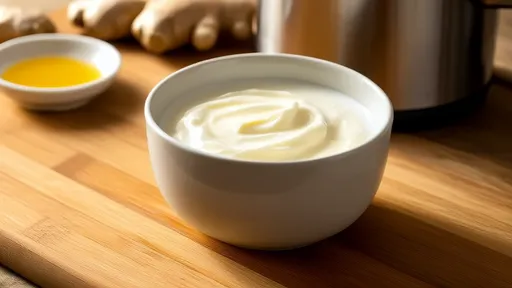
In the quiet corners of traditional Chinese kitchens, a delicate dessert whispers tales of culinary alchemy. Ginger milk curd, or Jiangzhuangnai, stands as a testament to the profound dialogue between ingredient and intuition. This silken creation, born from the marriage of fresh ginger juice and warmed milk, appears simple in its short ingredient list yet demands a near-scientific precision. The magic, and the challenge, lies entirely in the critical interplay of two elements: the enzymatic potency of the ginger and the exact thermal state of the milk. To master this dish is to understand a fragile biochemical ballet, where a single degree or a moment’s hesitation separates a flawless gel from a soupy disappointment.
The heart of the entire reaction beats within the humble ginger root. The key agent is a protease enzyme known as zingibain. This protein-digesting enzyme is the catalyst that transforms liquid milk into a soft, pudding-like solid. However, its power is not a constant. The vitality of this enzyme is a fickle thing, influenced by a multitude of factors that begin long before the ginger meets the grater. The variety of ginger used plays a significant role; older, more mature ginger tends to possess a higher concentration of the necessary enzymes compared to its younger, milder counterparts. The season of harvest also impacts its strength, with ginger dug up in winter often being the most potent.
Furthermore, the treatment of the ginger post-harvest is crucial. Freshness is non-negotiable. A ginger root that has been sitting for weeks, slowly drying out, will have a dramatically reduced enzymatic activity. The preparation method is equally vital. Grating the ginger is the most effective way to rupture the maximum number of plant cells and liberate the enzyme-rich juice. Using a blender can sometimes incorporate too much air or even generate heat, potentially degrading the delicate proteins you are trying to harness. The juice must be freshly extracted; letting it sit for more than ten or fifteen minutes can lead to a significant drop in its curdling power as the enzymes begin to denature naturally at room temperature.
On the other side of this delicate equation is the milk. Not just any milk will do. The protein content is paramount. Whole milk, with its higher fat and protein levels, provides more material for the enzymes to work on, resulting in a richer and firmer set. The milk must be heated, but this is the step where most attempts falter. The target is a very specific temperature window, typically cited as between 70 and 80 degrees Celsius. This is not a random range but a carefully defined thermal sweet spot.
Heating the milk serves two essential purposes. First, it pasteurizes the milk, but more importantly, it denatures the whey proteins in the milk. This process of unraveling the proteins makes them vastly more vulnerable and accessible to the attack of the zingibain enzyme from the ginger. If the milk is too cold, below this threshold, the proteins remain largely coiled and protected. The ginger enzymes cannot gain enough traction to form a stable network, and the mixture will simply remain a flavored liquid. If the milk is too hot, nearing or reaching boiling point, you scorch the milk and, most catastrophically, destroy the very ginger enzyme the moment it is added. Pouring 100-degree milk onto ginger juice is a surefire way to kill its curdling ability instantly, resulting in a spicy but utterly liquid drink.
The meeting of these two components is the moment of truth. The active ginger juice should be waiting in the bowl. The correctly heated milk must then be poured from a height—this "crashing" is where the dish gets its name, "jiangzhuangnai," or "ginger-crashed-milk." This action serves to mix the two elements thoroughly and instantly without the need for stirring, which could disrupt the initial formation of the gel. Once combined, the vessel must not be moved, jostled, or agitated. It is left completely undisturbed for a minimum of seven to ten minutes. This period of quiet is when the enzymatic magic happens, as the zingibain systematically cleaves the milk proteins, allowing them to rebond into a delicate, three-dimensional matrix that traps the water and fat, creating the signature tender, quivering texture.
Mastering ginger milk curd is therefore an exercise in controlled variables. It is a recipe that cannot be rushed and one that demands respect for the ingredients. It teaches the cook that true simplicity in food is often an illusion, masking a deep complexity that hinges on perfect balance. The reward for this diligence is a dessert of sublime elegance: subtly spicy, naturally sweet, and with a texture so ethereal it seems to melt away the moment it touches the tongue. It is a timeless lesson in the beautiful precision of traditional cooking.
By /Aug 20, 2025
By /Aug 20, 2025
By /Aug 20, 2025
By /Aug 20, 2025

By /Aug 20, 2025
By /Aug 20, 2025
By /Aug 20, 2025
By /Aug 20, 2025
By /Aug 20, 2025
By /Aug 20, 2025
By /Aug 20, 2025
By /Aug 20, 2025
By /Aug 20, 2025
By /Aug 20, 2025
By /Aug 20, 2025
By /Aug 20, 2025
By /Aug 20, 2025
By /Aug 20, 2025

By /Aug 20, 2025
By /Aug 20, 2025
