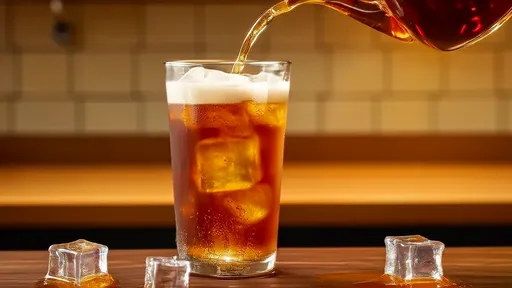
In the bustling night markets of Taiwan and the trendy urban cafes from Tokyo to Toronto, there exists a beverage that is as much a spectacle as it is a refreshment. The hand-shaken bubble tea, with its frothy crown and symphony of clinking ice, represents a fascinating intersection of culinary art, physics, and sensory experience. The seemingly simple act of vigorously shaking tea, milk, and ice in a cocktail shaker initiates a complex chain of physical reactions that are crucial to crafting the drink's signature character: its rapid chill and its luxurious, persistent foam.
The journey to the perfect cup begins not with the shake, but with the ice. The choice of ice is a critical, yet often overlooked, variable. Large, dense cubes melt slower, providing a powerful cooling effect without excessive and premature dilution. Smaller, more fragmented ice, however, offers a greater total surface area, chilling the liquid mixture more quickly but also melting faster, which can water down the flavors if the shaking is not timed with precision. The bartender, or tea artisan, must possess an intuitive understanding of this balance. The goal is to achieve a core temperature that shocks the palate with coolness while preserving the integrity of the tea's nuanced notes and the sweetness of the syrup.
The mechanism of cooling in a sealed shaker is a masterclass in thermodynamics. As the kinetic energy from the violent shaking is transferred to the ice cubes, they begin to fracture and melt. The phase change from solid ice to liquid water is an endothermic process, meaning it absorbs a significant amount of heat energy from its surroundings—in this case, the warm tea and milk mixture. This rapid absorption of heat is what causes the temperature of the liquid to plummet dramatically in a matter of seconds, far more efficiently than simply stirring it in a glass. This quick-freeze approach locks in the fresh-brewed aroma of the tea, a quality that is often lost when beverages are left to cool gradually.
Simultaneously, another, more visible transformation is taking place. The violent agitation of the liquid does more than just chill it; it aerates it. As the shaker is thrust through the air, the liquid inside is forced to the bottom and then violently pulled upward, creating a turbulent vortex. This motion traps countless microscopic air bubbles within the liquid. In a plain tea, these bubbles would be fleeting. However, the presence of key compounds acts as a natural surfactant, creating a stable foam. The proteins found in dairy milk or creamy non-dairy alternatives are primary actors here. These proteins have hydrophobic and hydrophilic ends, allowing them to surround air bubbles, lower the surface tension of the liquid, and form a stable film that prevents the bubbles from immediately popping.
For dairy-free versions, the plot thickens. The natural compounds in black tea itself, particularly tannins and saponins, also possess surfactant-like properties. Tannins, which give tea its characteristic bitterness and astringency, can help to stabilize air bubbles. Saponins, named from the Latin word for soap ("sapo"), are natural compounds that create a soapy, frothy consistency when agitated. They are the secret weapon behind the rich, foamy head on a traditional black tea punch or a vigorously whisked matcha. In a milk-free shaken tea, it is this combination of tannins and saponins that collaboratively builds and sustains the foam structure, creating a velvety texture that is entirely plant-based.
The final texture and mouthfeel of the foam are a direct result of the shaking technique itself. The intensity, duration, and even the rhythm of the shake are all variables controlled by the human hand. A short, weak shake will produce large, unstable bubbles that coalesce and disappear quickly, resulting in a flat drink. Conversely, a long, extremely vigorous shake can over-aerate and incorporate too much air, creating a foam that is too light and insubstantial, almost like a meringue that dissolves on the tongue without weight. The ideal technique—often a rapid, forceful shaking for a precise 15-20 seconds—produces a foam comprised of very fine, tight bubbles. This microfoam is dense, creamy, and remarkably persistent, sitting atop the tea like a cloud and delivering a rich texture with every sip.
This entire process is a beautiful demonstration of food science in action. It is a controlled application of force and energy to manipulate state changes and colloidal formations. The shake simultaneously solves two problems: it achieves instant cooling through phase-change thermodynamics and constructs a stable gas-in-liquid colloidal dispersion, which we see and taste as foam. This is why the drink cannot be truly replicated by simply mixing ingredients in a blender or with a spoon; those methods either incorporate too much air too roughly or fail to create the necessary pressure and shear force to form stable micro-bubbles.
Beyond the laboratory, the shake has become a cultural performance. The rhythmic, percussive sound of a shaker is the soundtrack to countless tea shops. It signals freshness and craft, a promise that the beverage has been prepared to order with skill and attention. This auditory cue, combined with the visual spectacle of the bartender's choreographed movements, enhances the customer's anticipation and overall sensory enjoyment before the drink even touches their lips. It transforms a transaction into a experience.
In conclusion, the humble hand-shaken bubble tea is a drink deceptively complex in its creation. It is a testament to the fact that some of the most profound culinary innovations arise from understanding and harnessing basic physical principles. The next time you witness that metallic cylinder dancing in a bartender's hands, know that you are watching a rapid chill-down and a foam genesis happening in real-time. It is a fleeting moment where water becomes ice, liquid becomes foam, and simple ingredients are elevated into an iconic global phenomenon, one shake at a time.
By /Aug 20, 2025
By /Aug 20, 2025
By /Aug 20, 2025
By /Aug 20, 2025

By /Aug 20, 2025
By /Aug 20, 2025
By /Aug 20, 2025
By /Aug 20, 2025
By /Aug 20, 2025
By /Aug 20, 2025
By /Aug 20, 2025
By /Aug 20, 2025
By /Aug 20, 2025
By /Aug 20, 2025
By /Aug 20, 2025
By /Aug 20, 2025
By /Aug 20, 2025
By /Aug 20, 2025

By /Aug 20, 2025
By /Aug 20, 2025
