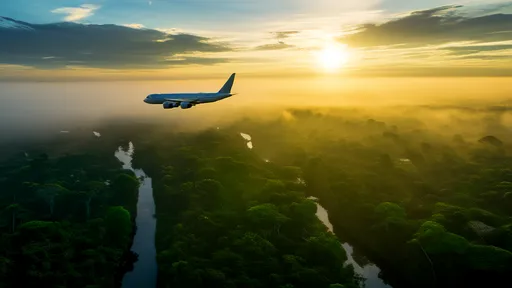
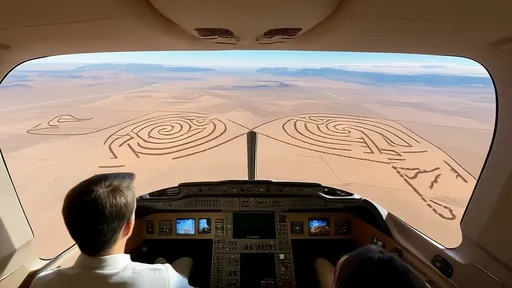
As the aircraft begins its descent, the world outside the window transforms. For hours, there has been nothing but the monotonous, brilliant blue of the sky above and a seemingly endless, fluffy white carpet of clouds below. The hum of the engines is a constant, lulling presence, a sound that marks the passage of time in a space that feels detached from it. Then, a shift. The plane angles downward, and the smooth cloud blanket begins to break. At first, it's just a few fissures, glimpses of a shadowed world far beneath. Then, the gaps widen, and the true landscape is revealed in a moment of breathtaking, almost disorienting, clarity.
The first sight of the Amazon rainforest from the air is not merely a visual experience; it is a profound sensory and psychological event. The initial impression is of a vast, undulating carpet of green, an immense living entity that stretches to every horizon, unbroken and seemingly infinite. It is a green so deep and varied it appears almost black in places, a mosaic of emerald, jade, olive, and viridian. The scale is incomprehensible, defying the mind's attempt to grasp it. This is not a landscape dotted with forests; this is a forest that is the landscape.
The aircraft continues its descent, piercing the final layer of clouds, and the sensation is one of crossing a threshold. One moment, you are in the sterile, dry, sun-drenched world above the clouds; the next, you are enveloped in the humid, dense atmosphere of the rainforest. The light changes, softening, filtered through the moisture-laden air. The world outside the window suddenly feels close, tangible, and overwhelmingly alive. This transition creates a powerful sense of temporal and spatial dislocation. You have not just traveled across continents; you have seemingly traveled through time, arriving in a primordial world that operates on a different clock, by different rules.
This feeling of a "dislocated timespace" is palpable. The rainforest below exists in a timescale all its own—a slow, relentless rhythm of growth, decay, and regeneration that has continued for millions of years. From this vantage point, the frantic pace of modern life, the concrete grids of cities, the neat lines of agricultural fields—all of it feels like a distant, fleeting dream. The Amazon is the enduring reality. Its rivers snake through the canopy like colossal, brown anacondas, not in straight, engineered lines, but in the lazy, meandering loops of a system with no master but gravity and time itself. There are no right angles here, only the chaotic, beautiful, and infinitely complex patterns of nature.
The humidity seems to seep through the very skin of the aircraft. You can almost smell it—the rich, fecund aroma of wet earth, decaying vegetation, and blooming life—a stark contrast to the recycled, sanitized air of the cabin. This moist air is the lifeblood of the forest, the engine of its breathtaking biodiversity. It carries the whispers of countless unseen dramas unfolding below: the hunt of a jaguar, the call of a howler monkey, the silent growth of a fungus on a fallen log. The plane offers a god's-eye view, but it is a view that teases, showing the stage but hiding the actors, making you acutely aware of the immense, hidden world beneath that unbroken canopy.
Looking down, the mind struggles to find reference points. A clearing appears, a small scar of brown and green, perhaps the site of a remote community or a recent blowdown from a storm. It looks like an island in a sea of trees, a tiny assertion of human scale against an indifferent vastness. The sight of the Amazon River itself is humbling. It is not so much a river as an inland sea of muddy water, so wide that in places you cannot see both banks at once, its surface dotted with sediment islands and lined with floating meadows. It is the great artery of the continent, and from above, its power and dominance over the landscape are absolute.
This aerial perspective forces a confrontation with stark, uncomfortable truths. The sheer scale of the forest is its most powerful feature, but also its most vulnerable. The view reveals the delicate balance and the brutal scars. In some areas, the green carpet is tattered. One can see the geometric, linear cuts of deforestation—rivers of red dirt roads feeding into patches of bare earth or struggling pastureland. These scars are like wounds on a living body, visible evidence of a conflict between the timeless rhythm of the forest and the immediate demands of a growing human population. The sight is a silent, powerful indictment, more eloquent than any report or statistic.
Yet, the overwhelming sensation is not one of despair, but of awe. The resilience of the forest is written in the landscape. Around the edges of the clearings, a brighter, lighter green signals the relentless advance of secondary growth, nature's stubborn reclamation project. The forest is fighting back. It is a dynamic, pulsating system, not a static museum piece. This view from above makes it clear that the Amazon is not simply a collection of trees; it is a complex, interconnected hydrological and meteorological engine. The moisture rising from the billions of leaves forms the very clouds the plane just descended through, creating a self-sustaining rain machine that influences weather patterns across the globe.
As the plane banks, offering a final, sweeping panorama before the final approach, the feeling of dislocation intensifies. You are about to land, to re-enter a world of schedules, buildings, and human noise. But the memory of that first glimpse, of that infinite green expanse seen through the humid air, creates a cognitive rift. For a few moments, you have hovered between two worlds—the one you came from and this ancient, vital, and fragile realm. The experience leaves an indelible mark, a understanding that the world contains places that still defy human comprehension and control.
The wheels touch down on the tarmac with a jolt and a roar. The spell is broken, but the vision remains. That first sight of the Amazon from the air is more than a travel memory; it is a lesson in scale, a meditation on time, and a visceral reminder of our planet's breathtaking beauty and profound fragility. It is a glimpse into a different timespace, a world that demands our respect, our understanding, and most urgently, our protection. The humid air that greeted the plane's descent is the breath of this living world, and for a fleeting moment, you have shared it.
By /Sep 28, 2025
By /Sep 29, 2025
By /Sep 29, 2025
By /Sep 29, 2025

By /Sep 28, 2025

By /Sep 29, 2025
By /Sep 29, 2025

By /Sep 28, 2025
By /Sep 28, 2025

By /Sep 29, 2025
By /Sep 29, 2025

By /Sep 28, 2025

By /Sep 28, 2025
By /Sep 29, 2025

By /Sep 29, 2025
By /Sep 28, 2025
By /Sep 29, 2025
By /Sep 28, 2025
By /Sep 28, 2025

By /Sep 28, 2025
