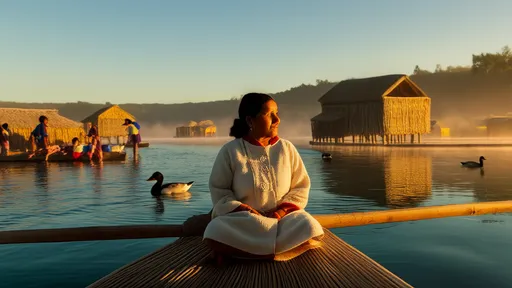
As our boat sliced through the crystalline waters of Lake Titicaca, the world's highest navigable lake, I found myself approaching a landscape that defied conventional understanding of human habitation. There, floating upon the reed-choked waters, lay the Uros Islands - man-made wonders constructed entirely from totora reeds. These floating islands, home to the Uros people for centuries, represent one of humanity's most ingenious adaptations to environment.
The first thing that strikes any visitor is the sensation of walking on water. The ground yields slightly beneath your feet, a gentle bounce reminding you that you stand not on solid earth but on layers upon layers of woven reeds. The islands themselves feel alive, breathing with the lake's rhythms. Each step sends subtle vibrations through the floating mat, connecting you immediately to the aquatic world beneath.
The Uros people trace their ancestry back to a time before the Incas, claiming to possess "black blood" that protects them from the lake's chill. Their creation story tells of existing before the sun, when the world was perpetually dark and cold. When the sun finally emerged, they retreated to the lake to avoid its burning rays, learning to build their world from the reeds that grew abundantly in the shallow waters.
Watching an Uros woman demonstrate island construction becomes a lesson in sustainable living. She shows how the dense roots of totora reeds are cut into blocks, then tied together with ropes made from the same reeds. New layers must be added constantly as the bottom layers rot away in the water. This constant renewal creates a living relationship between the people and their environment - they cannot neglect their foundations without risking their entire world dissolving back into the lake.
The islands range in size from small family dwellings to communal spaces large enough for several families. Each represents a delicate balance between human needs and natural limitations. Too large, and the island becomes unstable; too small, and it cannot support life. The Uros have perfected this balance through generations of trial and error, knowledge passed down not through written manuals but through lived experience.
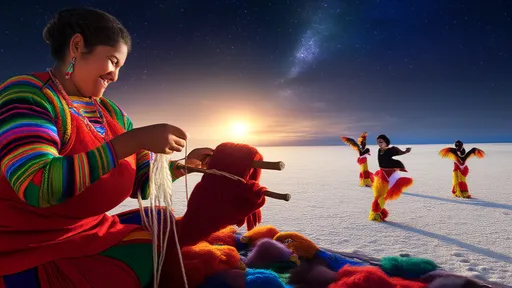
Life on the water dictates every aspect of Uros culture. Their reed boats, some decorated with elaborate animal figures, serve as their connection to the mainland and other islands. Fishing provides their primary protein source, while the reeds themselves offer multiple uses - as food (the white base is rich in iodine), medicine, and building material. Even their handicrafts, sold to tourists, reflect their aquatic existence, woven from the same reeds that form their world.
As I sat in a reed hut, listening to the gentle lapping of water beneath the floor, I contemplated how this floating existence shapes consciousness. The Uros perceive stability differently from land-dwellers. Their world moves with wind and current, requiring constant adjustment and awareness. This fluid existence has cultivated a people remarkably adaptable yet deeply rooted in tradition.
Modern pressures have inevitably transformed Uros life. Solar panels now dot the islands, powering lights and small televisions. Young people increasingly seek education and opportunities on the mainland. Tourism provides crucial income but also transforms their relationship with visitors from chance encounters to economic transactions. The islands closest to Puno have become regular stops on tourist routes, while more distant islands maintain greater isolation.
The Uros face the delicate challenge of embracing useful modern innovations while preserving their unique identity. Some fear that as younger generations adopt mainland lifestyles, the ancient knowledge of island-building and maintenance may fade. Yet others see resilience in their people's history of adaptation. After all, surviving for centuries on floating reed islands demonstrates remarkable capacity for innovation within tradition.
What struck me most profoundly was the Uros' temporal perspective. Living on a surface that constantly decays and renews, they understand impermanence in their very bones. Their world requires continuous maintenance - there are no permanent structures, only ongoing processes. This stands in stark contrast to Western concepts of property and permanence, offering alternative ways to conceptualize our relationship with our environments.
As climate change affects water levels and weather patterns, the Uros face new challenges. Unpredictable rains and shifting lake ecology threaten the totora reeds that form their world's foundation. Their future depends on the delicate balance they've maintained for centuries - but in a world where the rules are changing faster than ever before.
Sitting with an Uros family as they cooked over a carefully contained fire on their reed platform, I realized their existence represents more than cultural curiosity. They embody principles increasingly relevant to our world: adaptation to environment, sustainable resource use, and community interdependence. In an era of climate change and environmental uncertainty, the Uros offer lessons in resilience born of necessity.
The floating islands of Lake Titicaca present more than an exotic tourist destination. They challenge our fundamental assumptions about how humans can live with nature. The Uros haven't merely settled on the water - they've learned to grow their world from it, creating a civilization that floats lightly upon the earth while maintaining deep cultural roots. As our boat pulled away, the islands appeared like water lilies on the lake's surface - natural yet crafted, temporary yet enduring, fragile yet resilient.
Perhaps what the Uros understand best is that all ground is ultimately floating - some surfaces merely disguise this truth better than others. Their choice to build visibly floating lives represents not limitation but profound wisdom about the nature of existence itself. In learning to live with constant motion and change, they've discovered stability of a different kind - one that flows with the world rather than resisting it.
By /Sep 28, 2025
By /Sep 29, 2025
By /Sep 29, 2025
By /Sep 29, 2025

By /Sep 28, 2025
By /Sep 29, 2025

By /Sep 29, 2025
By /Sep 28, 2025
By /Sep 28, 2025
By /Sep 29, 2025
By /Sep 29, 2025

By /Sep 28, 2025
By /Sep 28, 2025
By /Sep 29, 2025
By /Sep 29, 2025
By /Sep 28, 2025
By /Sep 29, 2025
By /Sep 28, 2025
By /Sep 28, 2025

By /Sep 28, 2025
