At the southernmost tip of South America, where the Andes mountains crumble into a labyrinth of fjords and the air carries a crystalline chill, lies a realm of elemental forces. This is Argentine Patagonia, a land sculpted by ice and wind, home to some of the planet's most dramatic and dynamic glacial landscapes. A journey here is not merely a trip; it is a pilgrimage to the raw edges of the world, culminating in the legendary city of Ushuaia and the thunderous spectacle of the Perito Moreno Glacier.
The adventure begins, aptly, at the End of the World. Ushuaia, the capital of Argentina's Tierra del Fuego province, clings to the slopes of the Martial Mountains, its colorful houses overlooking the Beagle Channel. This city wears its title with a mix of pride and melancholy. It is a place of departure and reflection, the last significant outpost before the vast, empty expanse of the Southern Ocean stretches toward Antarctica. The air here is different—thin, pure, and charged with a sense of finality. Visitors stroll along the waterfront, watching albatrosses glide over waters that are a deep, forbidding blue, while the history of explorers, missionaries, and prisoners whispers from the wooden buildings of the old town.
From Ushuaia, the true immersion into the glacial world begins. Venturing into Tierra deluego National Park, one encounters a landscape still being shaped by ice. Dwarf forests of lenga trees, stunted and twisted by relentless winds, give way to peat bogs and serene lakes like Roca and Fagnano. Here, smaller glaciers cling to the cirques of the mountains, their meltwater feeding rivers that run the color of milky jade, heavy with glacial flour—the fine sediment ground by the immense pressure of moving ice. This is a subtle introduction to the power of glaciers, a quiet prelude to the roaring crescendo that awaits further north.
The journey northward through Argentine Patagonia is a traverse through a vast, windswept canvas. The arid steppe, punctuated by guanacos grazing on tough shrubs, gradually yields to the towering peaks of the Andes. The destination is Los Glaciares National Park, a UNESCO World Heritage site and the crown jewel of Patagonia's icy wonders. And within this park, the undisputed king is the Perito Moreno Glacier.
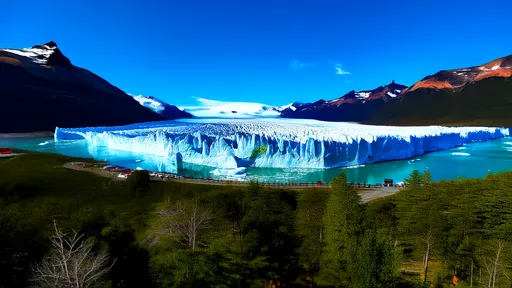
Nothing can truly prepare a visitor for the first sight of Perito Moreno. It is not a static monument of ice but a living, breathing, and roaring entity. Part of the Southern Patagonian Ice Field, the third-largest reserve of fresh water on the planet, the glacier is a colossal river of ice measuring 30 kilometers in length and with a face that towers up to 74 meters above the waterline of Lago Argentino. Its most astonishing feature is its stability; while most glaciers worldwide are retreating at an alarming rate, Perito Moreno is in a state of equilibrium, advancing and retreating in a delicate, mysterious balance.
The experience of the glacier is multisensory. The first impression is visual: an overwhelming wall of ice that stretches across the horizon. The color is a mesmerizing palette of brilliant whites and deep, penetrating blues. These azure hues, most intense in the crevasses and ice caves, are not a trick of the light but a physical phenomenon. The dense ice absorbs every color of the spectrum except blue, which it scatters back to the observer's eye. The surface is a chaotic topography of seracs—towering ice pinnacles—and deep, shadowy fissures, a testament to the immense pressures and slow, inexorable flow of the ice river.
Then comes the sound. The silence of the surrounding landscape is regularly shattered by thunderous cracks and explosive roars. These are the sounds of calving, the process where giant blocks of ice break from the glacier's face and crash into the turquoise waters of the lake. Watching a serac the size of a building detach, tumble in slow motion, and then explode upon impact is a humbling display of nature's power. The resulting waves ripple across the lake, and the sound echoes off the surrounding mountains long after the ice has settled. Visitors can witness this breathtaking spectacle from a series of metal walkways and balconies built along the peninsula facing the glacier, offering different vantage points and the chance to spend hours simply watching and listening to the ice.
For a more intimate encounter, boat tours navigate the icy waters close to the glacier's face. From this perspective, the scale becomes even more awe-inspiring. The ice wall looms overhead, and the occasional calving event feels immediate and visceral. The air temperature drops noticeably, and the boat floats amongst icebergs of every shape and size, some as clear as crystal, others clouded with ancient air bubbles.
The significance of Perito Moreno extends beyond its breathtaking beauty. It serves as a vital barometer for the health of our planet's cryosphere. Its unusual stability provides scientists with a unique laboratory to study glacial dynamics. Researchers monitor its movements, its mass balance, and its interaction with the climate, seeking clues to understand the rapid changes affecting glaciers elsewhere. In a world grappling with climate change, standing before Perito Moreno is a poignant reminder of the fragility and power of these frozen reservoirs.
To contrast the colossal scale of Perito Moreno, a visit to the nearby Upsala Glacier offers a different, more melancholic perspective. Accessible only by a longer boat journey through Lago Argentino's northern arm, Upsala is a behemoth in retreat. The journey to its face is a navigation through a floating cemetery of icebergs, some as large as small islands. The glacier itself, while vast, is receding rapidly, its terminus fractured and diminished. The sight is a powerful, silent testament to the warming climate, a stark counterpoint to the vigorous activity of Perito Moreno.
The journey to Argentina's glacial south is ultimately a transformative experience. It begins in the reflective solitude of Ushuaia, at the edge of the known world, and culminates in the primal theater of Perito Moreno. It is a voyage that engages all the senses and stirs deep reflection on time, nature, and humanity's place within it. The memory of the thunderous calving ice, the profound silence of the peaks, and the intense, almost supernatural blue of the glacier remains etched in the mind long after one has returned from the end of the world.
By /Sep 28, 2025
By /Sep 29, 2025
By /Sep 29, 2025
By /Sep 29, 2025

By /Sep 28, 2025
By /Sep 29, 2025
By /Sep 29, 2025

By /Sep 28, 2025
By /Sep 28, 2025

By /Sep 29, 2025
By /Sep 29, 2025

By /Sep 28, 2025

By /Sep 28, 2025
By /Sep 29, 2025
By /Sep 29, 2025

By /Sep 28, 2025
By /Sep 29, 2025
By /Sep 28, 2025
By /Sep 28, 2025

By /Sep 28, 2025
